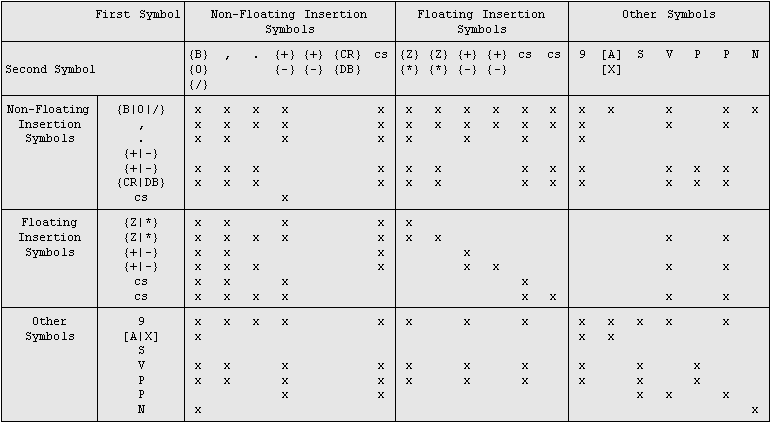
The PICTURE clause describes the general characteristics and editing requirements of an elementary item.
{PICTURE} IS Character-String
|
{PICTURE} IS X ANY LENGTH
|
{PICTURE} IS Character-String VARYING
|
|
1.
|
The PICTURE clause can be specified only at the elementary item level.
|
|
2.
|
Character-String consists of certain allowable combinations of characters in the COBOL character set used as symbols. The allowable combinations determine the category of the elementary item.
|
|
5.
|
The PICTURE clause must be specified for every elementary item, except those specifying Usage-String-2.
|
|
a.
|
Its PICTURE character-string can contain only the symbol 'A'; and
|
|
a.
|
Its PICTURE character-string can contain only the symbols '9', 'P', 'S', and 'V'. The number of digit positions that can be described by the PICTURE character-string must range from 1 to 36 inclusive; and
|
|
a.
|
Its PICTURE character-string is restricted to certain combinations of the symbols 'A', 'X', '9', and the item is treated as if the character-string contained all 'X's. A PICTURE character-string which contains all 'A's or all '9's does not define an alphanumeric item, and;
|
|
a.
|
Its PICTURE character-string can contain one or more occurrences of the symbol 'N'.
|
|
a.
|
Its PICTURE character-string is restricted to certain combinations of the following symbols: 'A', 'X', '9', 'B', '0', and '/'; and must contain at least one 'A' or 'X' and must contain at least one 'B' or '0' (zero) or '/' (slant).
|
|
a.
|
Its PICTURE character-string is restricted to certain combinations of the symbols 'B', '/', 'P', 'V, 'Z' '0', '9', ',', '.', '*', ' + ', '-', 'CR', 'DB', and the currency symbol. The allowable combinations are determined from the order of precedence of symbols and the editing rules; and
|
|
ii.
|
The character-string must contain at least one '0', 'B', '/', 'Z', '*', '+', ',', '.', '-', 'CR', 'DB', or the currency symbol.
|
|
a.
|
Its PICTURE character-string must contain at least one symbol 'N'; and
|
|
9.
|
The size of an elementary item, where size means the number of character positions occupied by the elementary item in standard data format, is determined by the number of allowable symbols that represent character positions. An unsigned nonzero integer which is enclosed in parentheses following the symbols 'A', ',', 'X', '9', 'P' 'Z', '*', 'B', '/', '0', '+', '-', or the currency symbol indicates the number of consecutive occurrences of the symbol. Note that the following symbols may appear only once in a given PICTURE: 'S', 'V, '.', 'CR', and 'DB'.
|
|
•
|
A - Each 'A' in the character-string represents a character position which can contain only an alphabetic character and is counted in the size of the item.
|
|
•
|
B - Each 'B' in the character-string represents a character position into which the space character will be inserted and is counted in the size of the item.
|
|
•
|
N - Each symbol 'N' represents a national character position that shall contain a character from the computer's national character set. Each symbol 'N' is counted in the size of the item.
|
|
•
|
P - Each 'P' in the character-string indicates an assumed decimal scaling position and is used to specify the location of an assumed decimal point when the point is not within the number that appears in the data item. The scaling position character 'P' is not counted in the size of the data item. Scaling position characters are counted in determining the maximum number of digit positions (36) in numeric edited items or numeric items. The scaling position character 'P' can appear only as a continuous string of 'P's in the leftmost or rightmost digit positions within a PICTURE character-string; since the scaling position character 'P' implies an assumed decimal point (to the left of 'P's if 'P's are leftmost PICTURE symbols and to the right if 'P's are rightmost PICTURE symbols), the assumed decimal point symbol 'V' is redundant as either the leftmost or rightmost character within such a PICTURE description. The symbol 'P' and the insertion symbol '.' (period) cannot both occur in the same PICTURE character-string.
|
In certain operations that reference a data item whose PICTURE character-string contains the symbol 'P', the algebraic value of the data item is used rather than the actual character representation of the data item. This algebraic value assumes the decimal point in the prescribed location and zero in place of the digit position specified by the symbol 'P'. The size of the value is the number of digit positions represented by the
PICTURE character-string. These operations are any of the following:
|
ii.
|
A MOVE Statement where the sending operand is numeric and its PICTURE character-string contains the symbol 'P'.
|
|
iii.
|
A MOVE Statement where the sending operand is numeric edited and its PICTURE character-string contains the symbol 'P' and the receiving operand is numeric or numeric edited.
|
|
•
|
S - The 'S' is used in a character-string to indicate the presence, but neither the representation nor, necessarily, the position of an operational sign; it must be written as the leftmost character in the PICTURE. The 'S' is not counted in determining the size (in terms of standard data format characters) of the elementary item unless the entry is subject to a SIGN clause which specifies the optional SEPARATE CHARACTER phrase.
|
|
•
|
V - The 'V' is used in a character-string to indicate the location of the assumed decimal point and may only appear once in a character-string. The 'V' does not represent a character position and therefore is not counted in the size of the elementary item. When the assumed decimal point is to the right of the rightmost symbol in the string representing a digit position or scaling position, the 'V’ is redundant.
|
|
•
|
X - Each 'X' in the character-string is used to represent a character position which contains any allowable character from the computer's character set and is counted in the size of the item.
|
|
•
|
Z - Each 'Z' in a character-string may only be used to represent the leftmost leading numeric character positions which will be replaced by a space character when the content of that character position is a leading zero. Each 'Z' is counted in the size of the item.
|
|
•
|
9 - Each '9' in the character-string represents a digit position which contains a numeric character and is counted in the size of the item.
|
|
•
|
0 - Each '0' (zero) in the character-string represents a character position into which the character zero will be inserted. The '0' is counted in the size of the item.
|
|
•
|
/ - Each '/' (slant) in the character-string represents a character position into which the slant character will be inserted. The '/' is counted in the size of the item.
|
|
•
|
, - Each ',' (comma) in the character-string represents a character position into which the character ',' will be inserted. This character position is counted in the size of the item.
|
|
•
|
. - When the symbol '.' (period) appears in the character-string it is an editing symbol which represents the decimal point for alignment purposes and, in addition, represents a character position into which the character '.' will be inserted. The character '.' is counted in the size of the item. For a given program the functions of the period and comma are exchanged if the clause DECIMAL-POINT IS COMMA is stated in the SPECIAL-NAMES paragraph. In this exchange the rules for the period apply to the comma and the rules for the comma apply to the period wherever they appear in a PICTURE clause.
|
|
•
|
+ - CR DB - These symbols are used as editing sign control symbols. When used, they represent the character position into which the editing sign control symbol will be placed. The symbols are mutually exclusive in any one character-string and each character used in the symbol is counted in determining the size of the data item.
|
|
•
|
* - Each '*' (asterisk) in the character-string represents a leading numeric character position into which an asterisk will be placed when the content of that position is a leading zero. Each '*' is counted in the size of the item.
|
|
•
|
cs - The currency symbol in the character-string represents a character position into which a currency symbol is to be placed. The currency symbol in a character-string is represented by either the currency sign or by the single character specified in the CURRENCY SIGN clause in the SPECIAL-NAMES paragraph. The currency symbol is counted in the size of the item.
|
where length is the length of the literal.
|
4.
|
Simple insertion editing. The ',' (comma), 'B' (space), '0' (zero), and '/' (slant) are used as the insertion characters. The insertion characters are counted in the size of the item and represent the position in the item into which the character will be inserted. If the insertion character ',' (comma) is the last symbol in the PICTURE Character-String, the PICTURE clause must be the last clause of the data description entry and must be immediately followed by the separator period. This results in the combination of ',.' appearing in the data description entry, or, if the DECIMAL POINT IS COMMA clause is used, in two consecutive periods.
|
|
6.
|
Fixed insertion editing. The currency symbol and the editing sign control symbols '+', '-', 'CR', 'DB' are the insertion characters. Only one currency symbol and only one of the editing sign control symbols can be used in a given PICTURE character-string. When the symbols 'CR' or 'DB' are used they represent two character positions in determining the size of the item and they must represent the rightmost character positions that are counted in the size of the item. If these character positions contain the symbols 'CR' or 'DB', the uppercase letters are the insertion characters. The symbol '+' or '-', when used, must be either the leftmost or rightmost character position to be counted in the size of the item. The currency symbol must be the leftmost character position to be counted in the size of the item except that it can be preceded by either a '+' or a '-' symbol. Fixed insertion editing results in the insertion character occupying the same character position in the edited item as it occupied in the PICTURE character-string. Editing sign control symbols produce the following results depending upon the value of the data item:
|
Floating insertion editing is indicated in a PICTURE character-string by using a string of at least two of the floating insertion characters. This string of floating insertion characters may contain any of the simple insertion characters or have simple insertion characters immediately to the right of this string. These simple insertion characters are part of the floating string. When the floating insertion character is the currency symbol, this string of floating insertion characters may have the fixed insertion characters 'CR' and 'DB' immediately to the right of this string.
In a PICTURE character-string, there are only two ways of representing floating insertion editing. One way is to represent any or all of the leading numeric character positions on the left of the decimal point by the insertion character. The other way is to represent all of the numeric character positions in the
PICTURE character-string by the insertion character.
If the insertion character positions are only to the left of the decimal point in the PICTURE character-string, the result is that a single floating insertion character will be placed into the character position immediately preceding either the decimal point or the first nonzero digit in the data represented by the insertion symbol string, whichever is farther to the left in the
PICTURE character-string. The character positions preceding the insertion character are replaced with spaces.
If all numeric character positions in the PICTURE character-string are represented by the insertion character, the result depends upon the value of the data. If the value is zero the entire data item will contain spaces. If the value is not zero, the result is the same as when the insertion character is only to the left of the decimal point.
To avoid truncation, the minimum size of the PICTURE character-string for the receiving data item must be the number of characters in the sending data item, plus the number of nonfloating insertion characters being edited into the receiving data item, plus one for the floating insertion character. If truncation does occur, the value of the data that is used for editing is the value after truncation. See
Standard Alignment Rules.
Zero suppression and replacement is indicated in a PICTURE character-string by using a string of one or more of the allowable symbols to represent leading numeric character positions which are to be replaced when the associated character position in the data contains a leading zero. Any of the simple insertion characters embedded in the string of symbols or to the immediate right of this string are part of the string.
In a PICTURE character-string, there are only two ways of representing zero suppression. One way is to represent any or all of the leading numeric character positions to the left of the decimal point by suppression symbols. The other way is to represent all of the numeric character positions in the
PICTURE character-string by suppression symbols.
If all numeric character positions in the PICTURE character-string are represented by suppression symbols and the value of the data is not zero the result is the same as if the suppression characters were only to the left of the decimal point. If the value is zero and the suppression symbol is 'Z', the entire data item, including any editing characters, is spaces. If the value is zero and the suppression symbol is '*', the entire data item, including any insertion editing symbols except the actual decimal point, will be '*'. In this case, the actual decimal point will appear in the data item.